Today is PrEP Day, and this year, it feels unusually personal to me.
I’m gay, and HIV prevention has been something I have cared about for a long time. I have followed developments in PrEP closely, talked about HIV prevention with people around me, and tried to contribute in small ways to HIV and LGBTQ+ advocacy. I developed an App to show the importance of using PrEP, I often volunteered why we need to use PrEP in WeChat or Twitter. For me, PrEP shows the duty to take control of our health, to reduce fear, and to make HIV prevention part of ordinary healthcare rather than something surrounded by stigma.
That was why I became so interested in Yeztugo, the newly available injectable PrEP option that only needs to be administered once every six months.
For someone who has taken an interest in HIV prevention for years, the idea of receiving PrEP only twice a year felt remarkable. Soon after arriving at UC Davis, I started asking whether I could receive it through UC SHIP.
At first, the answer seemed to be no.
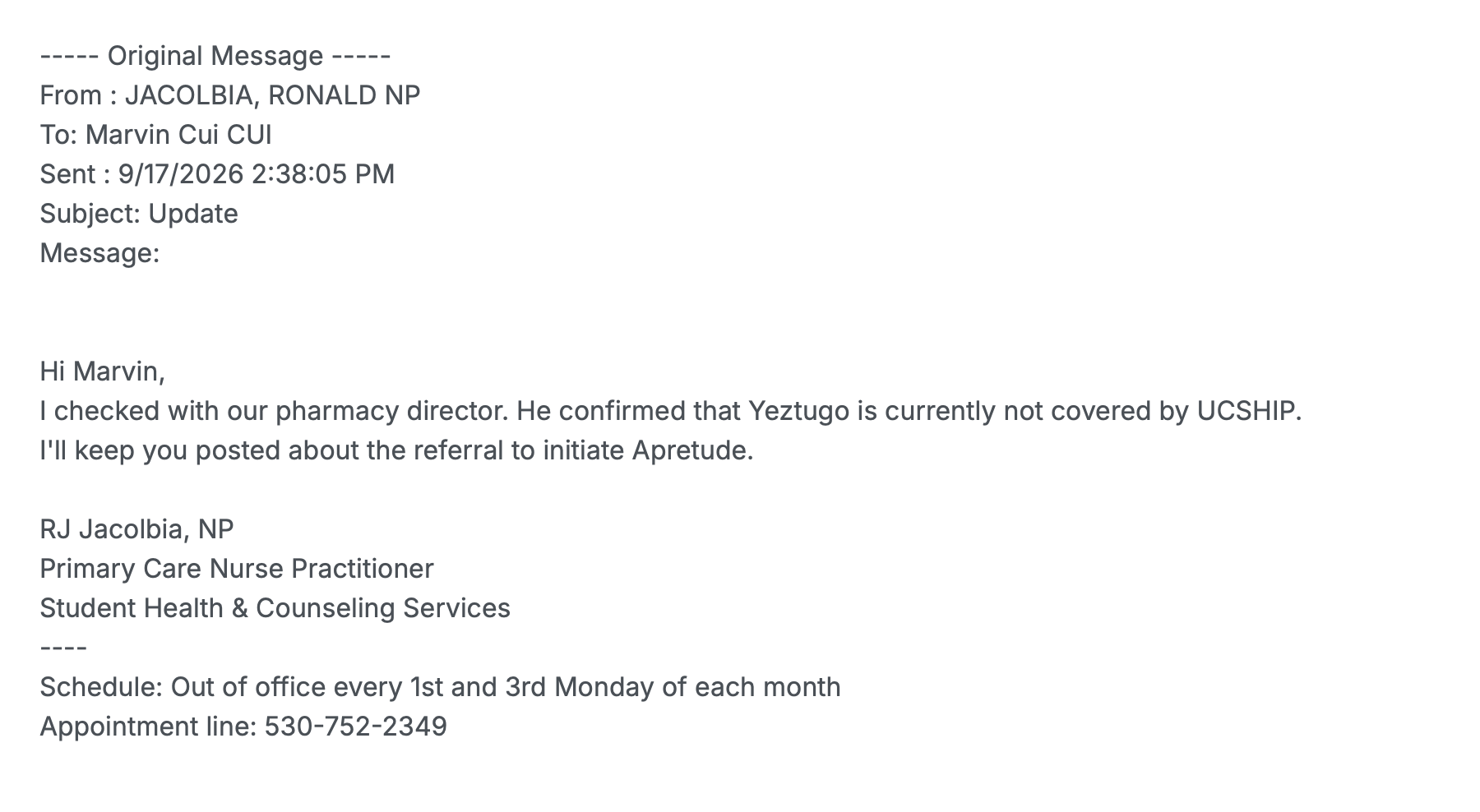
My provider checked with the pharmacy director and told me that Yeztugo was not covered by UC SHIP. The alternative was Apretude, another injectable PrEP medication. That answer made sense when looking at the pharmacy side of the insurance system. UC SHIP uses Optum Rx for pharmacy benefits, and the relevant materials direct patients who need injectable PrEP toward Apretude.
But I kept looking.
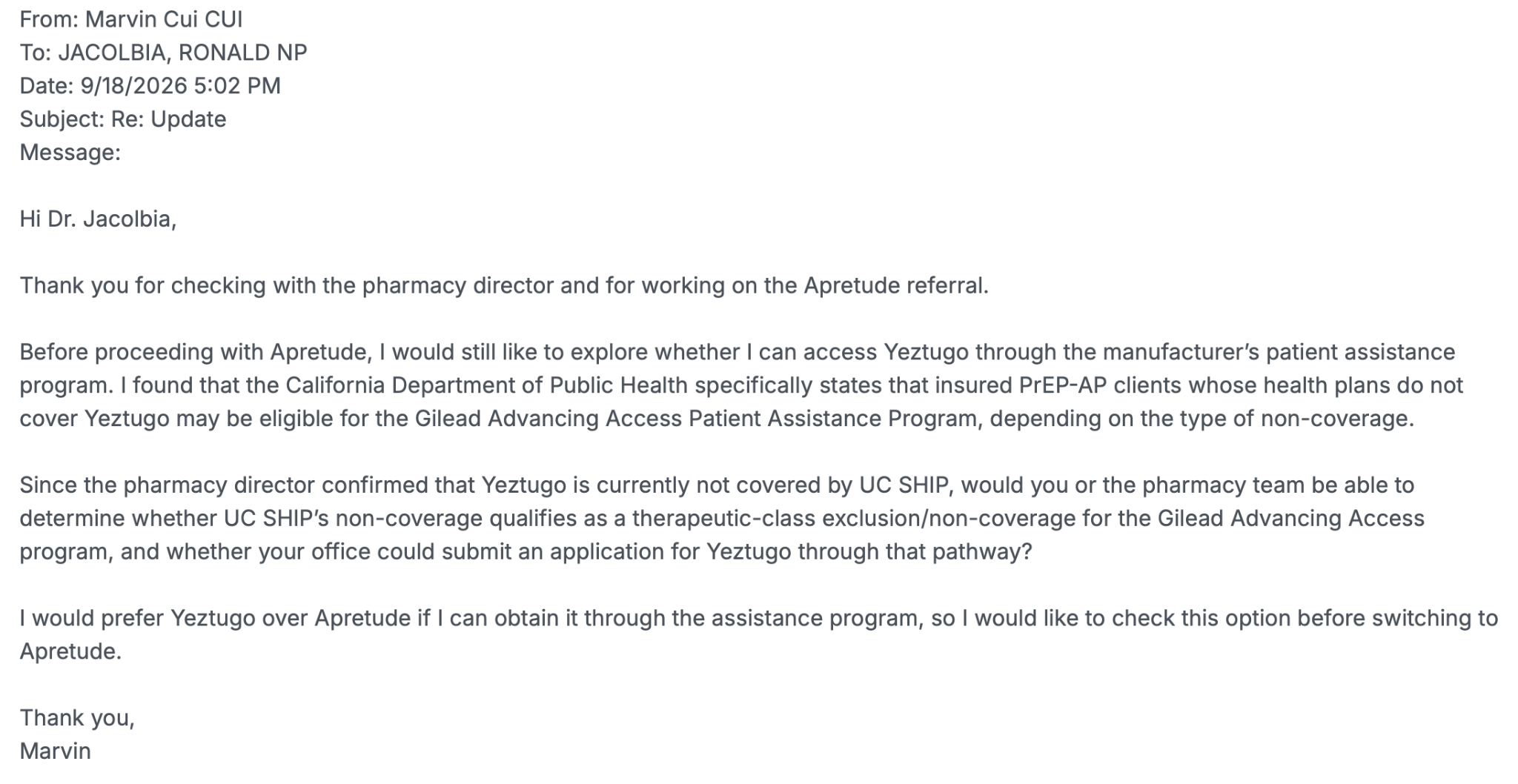
I went through insurance documents, coverage policies, manufacturer information, and California PrEP resources. Eventually, I noticed something that changed the situation: UC SHIP’s Anthem Blue Cross coverage has both Pharmacy Benefits and Medical Benefits, and Yeztugo appeared in the medical-benefit pathway.
That distinction sounds bureaucratic, because it is. But it mattered enormously.
Instead of trying to have Yeztugo covered as a pharmacy benefit, I asked whether it could be submitted through the medical-benefit pathway. That process required more work from the healthcare team and additional documentation, but my providers were willing to pursue it.
And it worked.
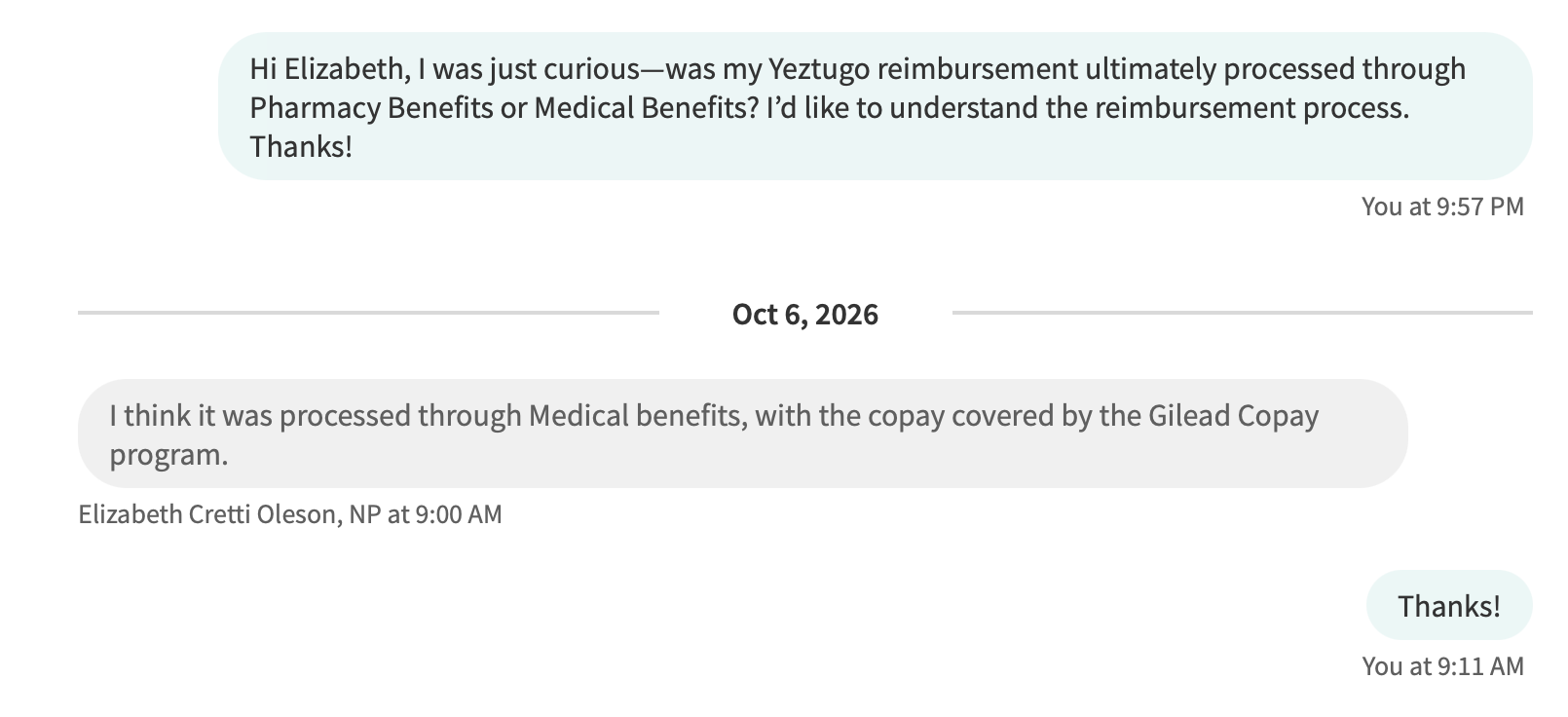
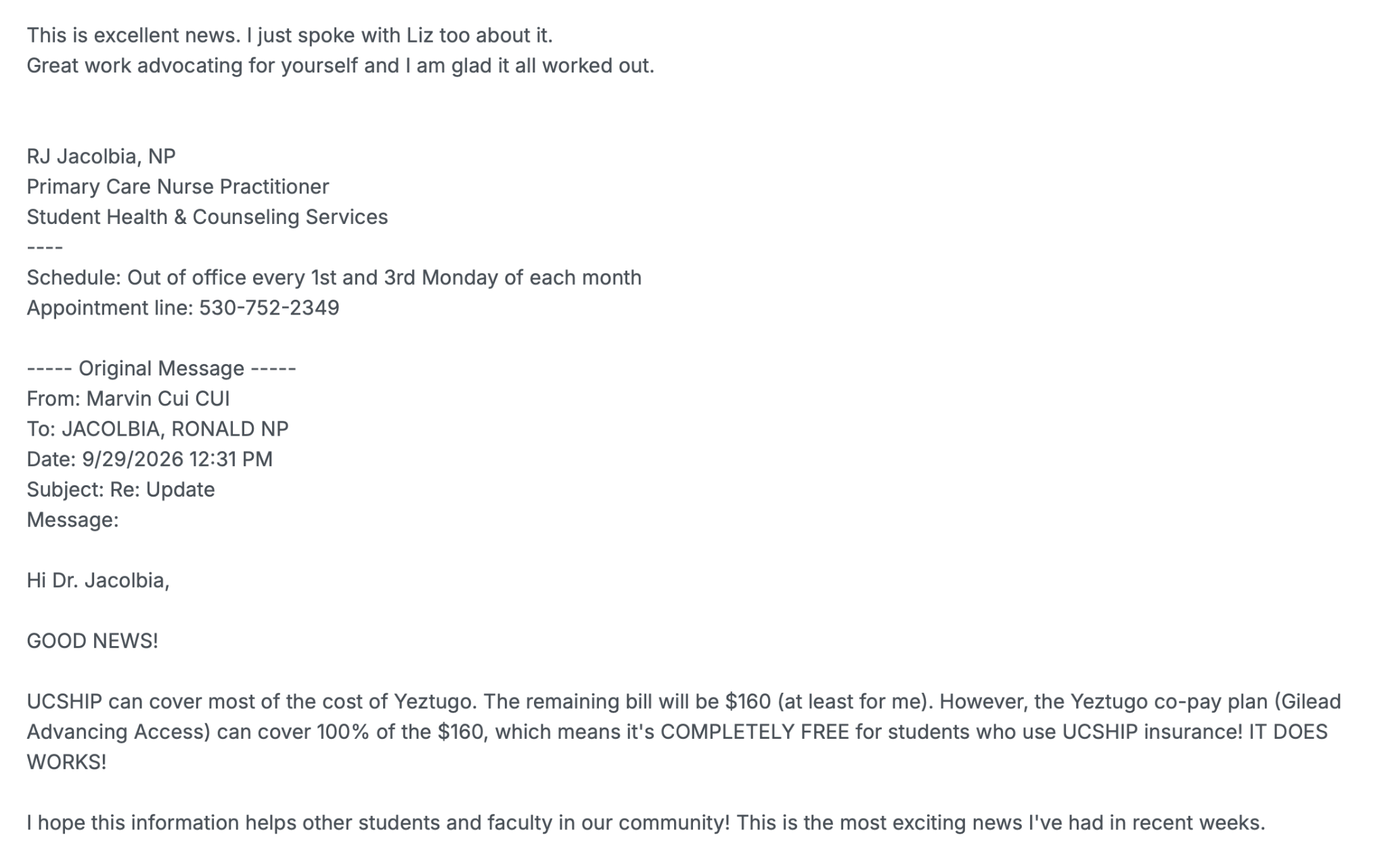
Anthem approved the treatment through the medical benefit and covered most of the cost. After insurance, about $160 remained. The clinic then used Gilead’s copay assistance program to cover that remaining amount.
My final out-of-pocket cost was $0.
A few weeks earlier, I had been told that UC SHIP did not cover Yeztugo. Now I had successfully received coverage for it.
What stayed with me most was not the $160, or even the approval itself. It was realizing how easily the answer could have remained “no” if I had stopped after the first coverage check.
Nobody involved was trying to deny me care. The problem was that healthcare reimbursement is complicated, and people naturally work within the pathways they use most often. A provider may search the pharmacy benefit, see that one medication is preferred, and reasonably conclude that another medication is unavailable. Somewhere else in a long insurance document, however, there may be another route.
Finding that route required reading, asking questions, sending messages, and repeatedly advocating for myself.
After everything was approved, my nurse practitioner wrote back:
“Great work advocating for yourself and I am glad it all worked out.”
That sentence meant a lot to me.
I also told the clinic that I hoped what we had learned could help other students and members of the UC Davis community. My case had forced us to figure out a reimbursement pathway that was not obvious at the beginning. Now that the clinic knows that pathway exists, perhaps the next person who asks about Yeztugo will have an easier experience than I did.
I may have been among the first UC SHIP members at UC Davis to receive Yeztugo this way. I cannot know that for certain, and being “first” is not really what matters to me.
What matters is that I will probably not be the last.
As a gay student, that is the part of this experience that makes me happiest. LGBTQ+ advocacy does not always happen through a large organization, a protest, or a campaign. Sometimes it happens when one person spends an unreasonable amount of time reading insurance documents, asks a question that nobody thought to ask before, and leaves behind a clearer path for whoever comes next.
On PrEP Day, that feels worth writing about.
STATEMENT: Due to my ADHD, my thoughts tend to be too scattered, so AI-assisted organization is quite common. But any viewpoint is an original creation of the human race.